Lessons of Hope From Age 93

Note to subscribers: I’ll continue with the series about my son Charlie next week. Thank you for being here.
At the beginning of this year, I woke up to a family group text from my mom that simply said, “I’ll be on TV at 9.45am,” along with a link. It was Sunday morning so I clicked on the link and there she was standing at the front of St. Luke’s United Methodist Church in Indianapolis being honored as a new member. At 92 years old, Mom was by far the oldest of the group. I love that this was something she did on her own. She didn’t tell any of us ahead of time.
A year earlier she had gotten the news that her cancer marker numbers for multiple myeloma was increasing. The treatment had stopped working. She was complaining about no quality of life.
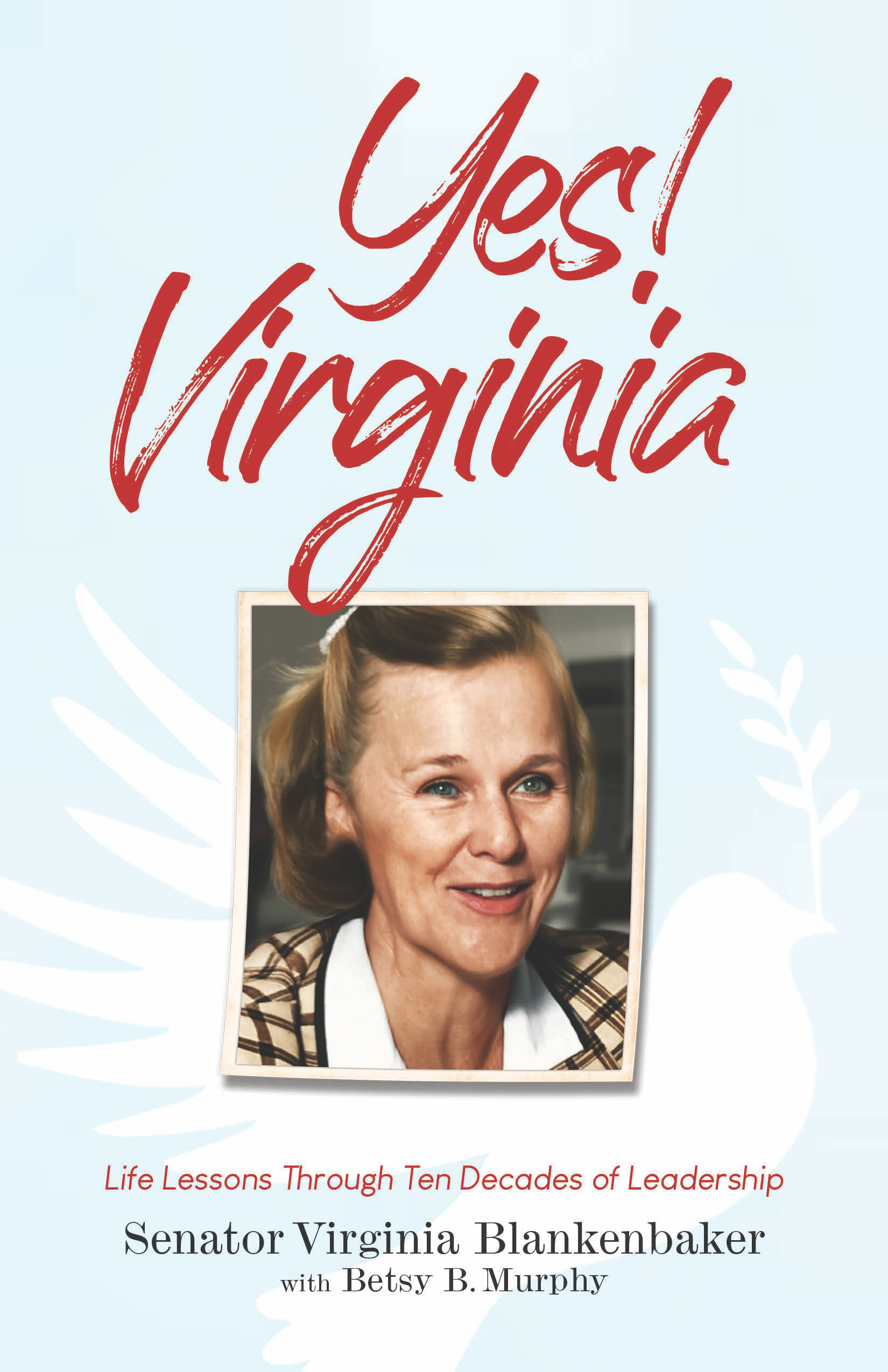
I don’t know many people who get better in their 90s. To honor Mom’s upcoming 93rd birthday on March 29th, I’m offering an uplifting story from her book, Yes! Virginia.
Read on if you are curious about the rest of the story.
EXCERPT FROM YES! VIRGINIA: LIFE LESSONS THROUGH TEN DECADES OF LEADERSHIP:
When I first met Virginia, I saw in her not only a patient with multiple myeloma but a woman whose quiet strength and moral clarity could fill an entire room. She had spent a lifetime leading, teaching, and advocating for justice, and she brought that same resolve to her illness. She believed deeply in our shared mission—to find a cure for multiple myeloma, not just for herself but for everyone who would come after her. That conviction fueled the work of my team and reminded us why research matters.
When the opportunity arose to try a new therapy in 2025, she didn’t hesitate. Her willingness to take that step—rooted in courage and trust—contributed directly to advances that have changed the course of this disease. Her remission was a triumph of science and spirit intertwined, proof that progress is possible when compassion and discovery meet.
But Virginia taught me something even deeper about healing. She understood that medicine alone cannot carry people through illness. She drew strength from her family, her faith, her friendships—including one with my own mother, whom she comforted at the end of her life. Watching her care for others while facing her own challenges taught me that healing often flows in both directions. The warmth, love, and purpose she embodied were as essential to her recovery as any treatment we administered.
Virginia reminded me that while we search for cures in the lab, healing also happens in the spaces between people—in kindness shared, in hope renewed, and in the belief that every life touched makes the next discovery possible.
~DR. RAFAT ABONOUR
Indiana University Simon Comprehensive Cancer Center
In January of 2025, bloodwork revealed that the multiple myeloma in my mom’s body was on the rise again. Under the care of Dr. Rafat Abonour and using two types of treatments that were so good they almost felt boutique, she had managed it for nearly ten years. Dr. Abonour is a leading researcher for multiple myeloma. We all felt she was fortunate to have him as her doctor.
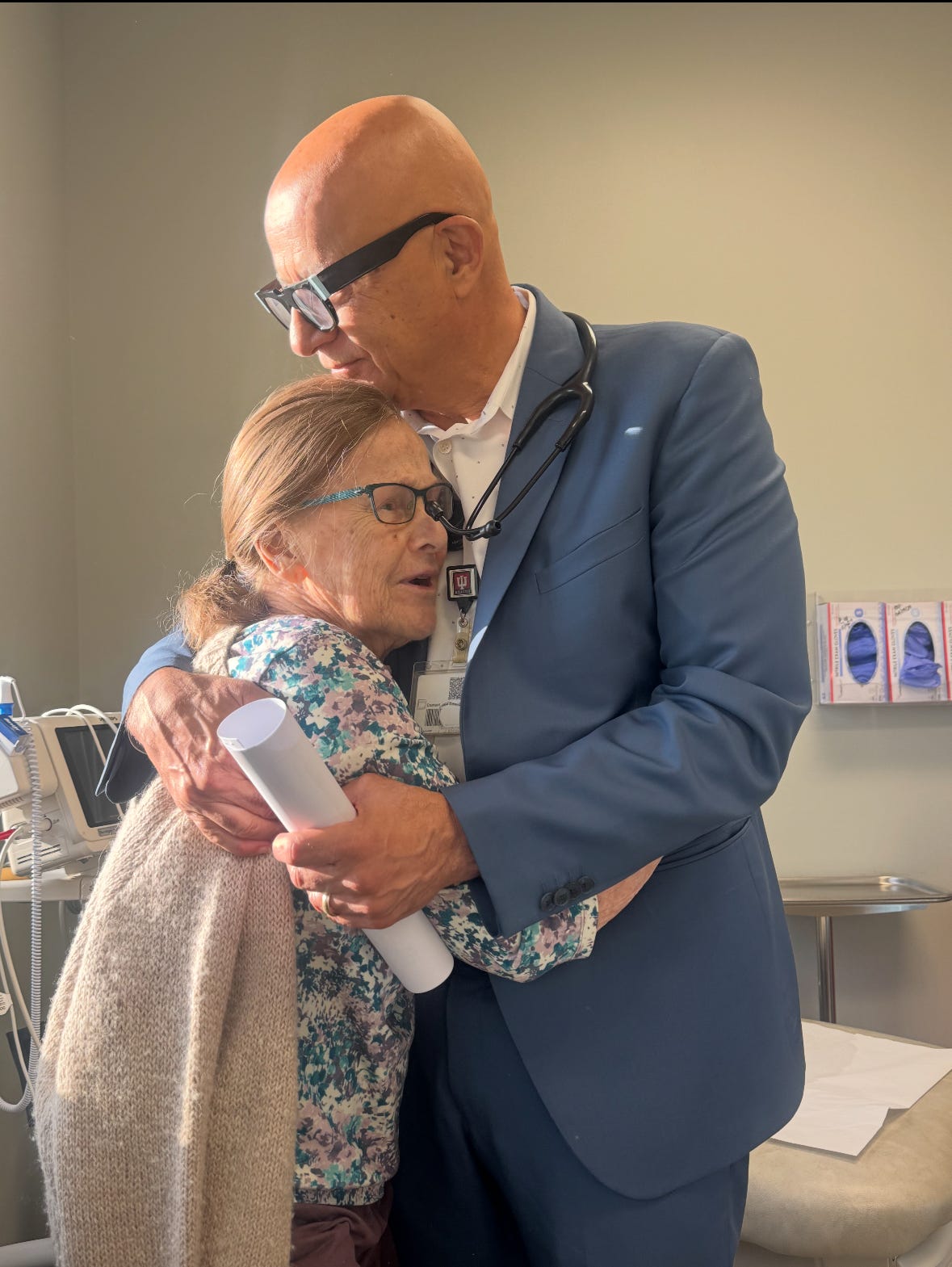
“Dr. Abonour travels all over the world giving seminars on what he’s doing with his cancer research while continuing to meet with his patients. He ends most of our appointments with a long hug,” Mom said. “My kids feel sorry for me that I have to go for my appointments and then infusions at the Indiana University Cancer Center, but I love it! They have good snacks and the staff is amazing—from the front desk to the nurses and aids and volunteers. And then Dr. Abonour makes you feel like you’re the most important person in the world.”
During the previous five years, Mom’s cancer had been manageable, even through the challenges of the pandemic and suddenly being cut off from family. Then she moved from her retirement center in Florida back to Indiana, where her new home was less than a mile from the cancer center. All her children lived in different states: Susan in Illinois, Sharon in Florida, David in Arizona, Jim in Ohio, and I lived in California to be close to my son Charlie and his two young daughters, Sunny and Ray. Plus, Mom had fifteen grandchildren and sixteen great-grandchildren living across the country. She was the matriarch of a family growing in all directions.
She was also witnessing her former Republican Party evolving into an organization that she didn’t recognize. What started as the rise of the Moral Majority in the party when she was running for office in the 1980s and 1990s had turned into a dangerous extreme of politics in this country. “I will never forget my fourth-grade teacher telling me that when I was elected president of the class, I represented everyone in the class, not just the ones who voted for me,” she said. “Now we are seeing elected leaders who are divisive, serving for their own benefit and power, and waging war against anyone or anything that is against them.”
A big shock for all of us came in 2022 when Charlie, my youngest son, died at the age of twenty-seven from an overdose due to fentanyl poisoning. As the world was getting louder, we forgot to listen to the whispers for help from loved ones in our own families. “I’d grieved the deaths of my three husbands, but I will never know the grief that comes with the death of a child,” Mom said. “Charlie had been struggling for years but in some ways, I think we all let him down. It was hard to watch Betsy and her other children grieve such a big loss. The only thing I could share with her was what a minister told me after the death of my first husband, John, that gave me some peace. He told me that if John had the choice to come back to be with me and Susan, our baby who was six months old when he died, John would make the choice to stay in heaven. I’ve heard enough stories to believe part of us doesn’t die. Part of us goes on, and I hope Betsy knows that she’ll be with Charlie again someday.”
I never watched my mother grieve any of her husbands. I didn’t even know the story of her first husband and my sister Susan’s birth father, John Bauerle, until I was in college. There were no photos of John in our house. He was never spoken of. It’s like that part of her life was left behind.
Mom came from a generation that didn’t complain, or grieve, or seem to process any emotions. She is not a hugger but she also said that her parents rarely hugged their children. Maybe the lack of physical affection goes back generations so it does warm my heart to see my son Willie give his Gramsie a big hug as soon as he walks into her home. He doesn’t wait for her to hug, he just reaches for her.
Before Charlie’s death, I’d only seen my mom cry four times in my life. And she was never a safe place for my own sadness and tears. If I ever started to share a hard story or painful moment, Mom always chose to end the call or leave the room. After Charlie died, Mom and I started sharing many tears together. She witnessed my tears without rushing them and then allowed her own sadness to take up space. We grieved Charlie together and we grieved some unspoken shared pain too.
Three years after Charlie’s death, my son Willie was headlining at a comedy club in Fort Wayne, Indiana. When I told mom that I was going to fly in from California for the show, she mentioned that Fort Wayne was where her first husband, John, was buried. “It’s in a cemetery on the southside,” she said. “I haven’t been there since the day he was buried (in 1957). Can we go to the show and visit the cemetery?”
It took me four days of research to discover where John Bauerle was buried. No one could remember. Even researching online didn’t reveal anything. Finally it was during “God moment” as mom calls it, when I just said a prayer to John asking for help in finding where his gravesite was located. Five minutes later an online search revealed his father’s death certificate and as I zoomed in I found the name of the cemetery, Lindenwood in Fort Wayne. I emailed them to ask if they could locate the father’s gravesite from his death in 1979 and if there was also a headstone for his son, John. Within an hour I received two photos from the cemetery of the headstones of John and his father.
A few weeks later, Mom and I drove two hours north from her home in Carmel, Indiana to Fort Wayne. It was a perfect fall day. As the sun shined on our conversation, Mom shared stories about her life with John that I was hearing for the first time. The story of meeting at Purdue University, the story of getting married on graduation day and going on a honeymoon to a state park in northern Indiana. I heard the story of the night John died. They loved to play cards and they were playing a game of hearts sitting up in bed with baby Susan sleeping between them. My mom liked to go to bed early but that night she stayed up late with John because he had a night flight with his squadron in the Air Force. They were having so much fun playing cards that they ignored the time and suddenly when it was time for him to leave for the night flight he was rushed. He left their home under the dark skies and Mom never saw him alive again.
Nearly seventy years after that night, Mom and I arrived at the Lindenwood cemetery a little before noon and even with a map we had trouble finding where John was buried. The cemetery was over 175 acres, it was one of the largest cemeteries in Indiana. There were 74,000 graves and we were looking for just one. Mom sat in the front seat of the parked car while I walked a large plot covered in mature oak trees looking at headstone after headstone hoping to find the one that said John Bauerle. Mom used a rollator so it would be unsafe for her to walk through the uneven lawn covered in grave stones.
“I think it’s over in that direction,” she said. I looked back at her and instead of seeing my 92 year old mother, I was now looking at a 24 year old woman who had planned a beautiful life with a man who was no longer alive. Finally, I saw three headstones at the edge of the road. Between the headstones of John H. and his wife, Leona B. (who died when her son John W. was 13) was the headstone of John W. born in 1933 and died in 1957. Mom got out of our rental car and with her cane walked slowly to the place she had last stood 68 years ago. Mom placed flowers at all their graves and then she reached for me and we hugged.
My mother’s move into a retirement center in Carmel, Indiana included reconnecting with old friends and making many new ones, but a downside was that at her age—now in her early nineties—friends were dying more often. And Mom had a few big falls, so there was constant concern about more of them.
Being in her nineties, as with every other decade of her life, didn’t stop her from running for office, this time at her retirement center which had so many clubs and activities that it didn’t seem like a retirement. “I ran for the board, and I was elected, but I didn’t get the committee I wanted because I was away, so they gave me what was left: the Health and Welfare Committee. I was told I needed to appoint five members within twenty-four hours. I considered quitting because that seemed unreasonable, but then I thought about all the people who had been empowered through serving, and so I considered the quieter residents and wrote down their names. I called each one and said, ‘I really need your help,’ and they all said yes. We ended up being one of the most popular committees, but by the end of 2024, I resigned from the position because I was getting double treatment for cancer and was constantly feeling tired.”
Mom had always been active and busy, and now we were seeing her slowing down. She was sleeping more and cancelling plans. Dr. Abonour wasn’t happy about her cancer marker numbers beginning to rise again. It meant that the current treatment, which had been so successful for the past several years, was no longer working. He proposed a newer treatment for her, but it came with potential side effects that needed to be monitored in the hospital. It meant a four- or five-day hospital stay and then another two weeks of monitoring at home. The other option was to do nothing and hope that the myeloma in her body would not spread too fast. Dr. Abonour always told her, “You have ten more years,” and we wanted to believe that was still true.
Every family member had a different view of what she should do. I didn’t want to see her put her body through any more trauma. Ultimately, it was Mom’s decision, and she chose the new treatment. “I’m committed to helping find a cure for multiple myeloma,” she said. “At this point, I’m willing to donate my body and be a guinea pig while I’m still alive to see if we can make progress in finding a cure. Also, I believe in Dr. Abonour.”
So just before her ninety-second birthday, Mom checked into the IU Cancer Center downtown for the first of four shots of the new treatment. I flew in from California to be with her during the treatment and for the two weeks beyond.
Mom was playful when checking into the hospital. She brought her knitting and Sudoku. But unlike the spa-like facilities at the cancer center in Carmel where she got her infusions along with warm blankets, good snacks, and pampering from everyone, she was now staying in a hospital wing filled with cancer patients who looked like they were in rough shape. We had to wait several hours for her to check in because the patient in the room before her had died.
Within hours of receiving the first shot, Mom was complaining of sharp pains through her body. It was stabbing pain, and she felt like she was on fire from the inside out. She had a fever and was getting confused. It was scary to observe. The hardest change was that she was often mean. It was like the chemicals flowing through her body, meant to save her, were changing her personality. We were informed of the possible side effects, but the changes and pain seemed extreme. Mom didn’t complain and didn’t give up, but after witnessing her suffering for twenty-four hours, I suggested that she stop the treatment, and she agreed. A nurse immediately gave her a shot to reverse the treatment, and within hours, she settled down and was able to rest.
I was guessing we would be discharged the next day, but instead the doctor on call (not Dr. Abonour) said that strong reactions to the first shot can often be followed by less intense reactions should Mom choose to continue the treatment. After seeing her in so much pain, I wanted her to quit. I wanted to take her home and let her enjoy the rest of the time she had left. But I was not surprised when, based on her trust in Dr. Abonour and his research, she decided to continue the treatment. Over the next few days, I watched her, and the next shots did not produce any extreme reactions. On day five, I was able to take her home.
A few weeks later, Mom celebrated her ninety-second birthday with my sister, Susan, and her husband Nick, but she didn’t want to be around too many people, which was unlike her. The treatment had left her even more exhausted than she was before. She was going through the motions of daily life, but it seemed like much of the joy was gone. New health issues were causing a bad outbreak of eczema, leaving the skin on her body, head, and face exposed and peeling. And she’d been losing some vision in both eyes for different reasons. Mom knitted constantly and for a few weeks, she was unable to see clearly enough to either knit or do Sudoku. There always seemed to be more pills and more doctors’ appointments. Finally, she said, “I have no quality of life anymore.”
Within four months, she had lost twenty pounds from her already tiny body. And then she found out that Dr. Abonour had taken a position with the University of Miami Cancer Center and would be moving to Florida within a few months. “Maybe it’s time to stop everything,” she said to me one day. Her parents had refused to go to the hospital at the end of their lives. They wanted to die at home—and they did. But I also knew Mom was good at rebounding, and her body seemed to have a healing superpower, so I was not surprised when at her final few monthly appointments with Dr. Abonour, she was declared cancer-free. The new treatment had worked!
“There is no detectable multiple myeloma in your body,” he said as he held her hand. Then she stood, and he gave her one last long hug before his move to Miami, saying, “You have ten more years.” She hugged harder and joked, “I packed a carry-on so I can go to Miami with you.”
The year before, Dr. Abonour had called Mom to tell her his own mother was close to death. Abonour was originally born in Palestine, then his family moved to Syria as refugees. He eventually moved to the United States and became a US citizen while devoting his life to finding a cure for multiple myeloma. When Dr. Abonour brought his mother, Abla Hamid, to Indiana to live with him and his wife Lisa, my mother made sure that Abla had someone to sit with at multiple myeloma fundraising events. “We didn’t speak the same language,” Mom said, “but we spoke the language of the heart. I loved her very much. I went and sat with Abla at their house a few days before she died. She’d been a refugee and against all odds had raised a family. And now her son was my doctor, saving so many lives and giving us hope.
“Before I die, I hope we can find a cure for multiple myeloma,” Virginia said. “A cure will save the lives of many, including maybe one of my children or grandchildren. And if that happens, it will be in part because of the research of a man born in Palestine to a woman who became my friend, Abla Hamid.”
“Leave it better than you found it,” my grandfather always said to Virginia and her siblings. If you have a garden, leave the land better than you found it. With your friendships, be the one who leaves everyone better than you found them. Be the teacher that every child needs and remembers. Make a difference in even the smallest way. Make each person feel like they matter (because they do).
As we completed this book, I saw over and over again how my mother has shown the way for others, but I also saw all the people who were way-showers for her, people who reminded her that she mattered. Even at 5’2”, she made a big difference in so many lives.
“When I was in fourth grade, it was the end of WWII, and my teacher gave us pen pals from other countries,” said Mom. “Mine was a boy from Italy, and we exchanged a few letters. What stayed with me was that a girl on a farm in Indiana could understand some of what a boy in Italy was going through at the end of the war. The older generations were the ones fighting the wars. It was up to the children to fight for peace. And I’m seeing the same thing today. I wish I were passing on a better world to my grandchildren, but I know they will be the ones to make it better.
“I’m concerned about the treatment of our immigrants. We are a country of immigrants. My great grandparents came here from Ireland and France. I have grandchildren who are married to partners from Japan, England, Argentina. Some of my great-grandchildren are from families with roots in Greece, Cuba, and Mexico.
“Love your neighbors. Even if you don’t agree with them, we still have to care about each other. Don’t be a bully or call people names. When you lead by example. Others notice. Keep speaking up for the underdog.
“I am hoping to see a woman president before I die. I was a Republican most of my life. My values are conservative, but I do not identify with the Republican Party of today. I voted for Kamala Harris in 2024 and was sad when she was defeated,” said Mom. “And I’m angry that there have been over 1,600 school shootings in the US since the Sandy Hook shootings, and we still don’t have common-sense gun laws like the ones I passed in Indiana in the 1980s. My father instilled in us to leave the world a better place, and I don’t see that happening right now.
“But I know I can still make a difference, and for as long as I’m alive, I will. Now that my cancer is in remission, maybe I’ll look at launching Grandmothers Mad as H About Gun Laws again. The way to create change is neighbor by neighborhood and then state by state. But I’m going to need help. I’ll start making a list.”